Turkey plastic packaging sourcing becomes risky when the buyer treats a catalogue description as a compliance file. A food-contact pack needs a defined use case, traceable material information and a release check that compares the agreed sample with production. That work starts before the purchase order.
For Turkish-market products, the Ministry of Agriculture and Forestry says food-contact materials must meet defined conditions and highlights producer or importer information, the business registration number, suitability marking where relevant, and use instructions as buyer-facing checks. Read the Ministry guidance on food-contact materials alongside the product specification.
What should a buyer define before asking Turkish packaging suppliers for a quote?
Define the food type, contact side, temperature, contact time, filling process, storage conditions, dimensions, resin or multilayer structure, print area, seal performance and target market. A quote without this scope cannot show whether a proposed tray, film, lid or container fits the intended use.
Ask each supplier to quote against the same specification sheet. Record version number, artwork status, tolerances, test method, sample quantity, lead time and the agreed approval point. This makes later comparisons possible and prevents a material substitution from being hidden inside a revised commercial offer.
How do food-contact rules change the sourcing file?
Food-contact compliance is product and use-case specific. For goods placed on the EU market, the European Commission describes a legal framework for food-contact materials, while the current EUR-Lex summary records that Regulation (EU) No 10/2011 governs plastic materials intended to contact food and that the 2025 amendment applies from 16 March 2025, subject to stated transition rules.
Request the supplier's applicable declaration or supporting compliance information for the exact structure and intended conditions of use. Do not assume that a document for a cold-food cup proves suitability for hot filling, fatty foods, repeated use or a different printed layer. The European Commission food-contact legislation page is a useful route map; the binding import and market-access analysis still depends on the destination market and product.
Which documents and evidence should be checked before production?
Use a short evidence register. It should connect the supplier entity, production site, product code, material structure, batch traceability, approved artwork and the stated food-contact use. The objective is to make a later sample, invoice and shipment record point to the same item.
- Supplier legal name, address and production-site confirmation.
- Specification with thickness, weight, dimensions and permitted tolerances.
- Food-contact declaration or test-supporting file matched to the proposed product.
- Signed golden sample, colour reference and seal or performance criteria.
- Batch coding, packing method and corrective-action contact.
For an EU-bound plastic item, consult the EUR-Lex summary of Regulation (EU) No 10/2011 when mapping the file. It explains the regulation's scope and the recent amendment status. It does not replace product-specific advice from the responsible compliance team.
How should sample approval differ from a production quality check?
A sample answers whether the proposed design can work. A production check asks whether the order actually matches that approved design. Keep the two decisions separate, especially where a converter changes resin lot, mould, ink supplier, thickness or packing configuration after sampling.
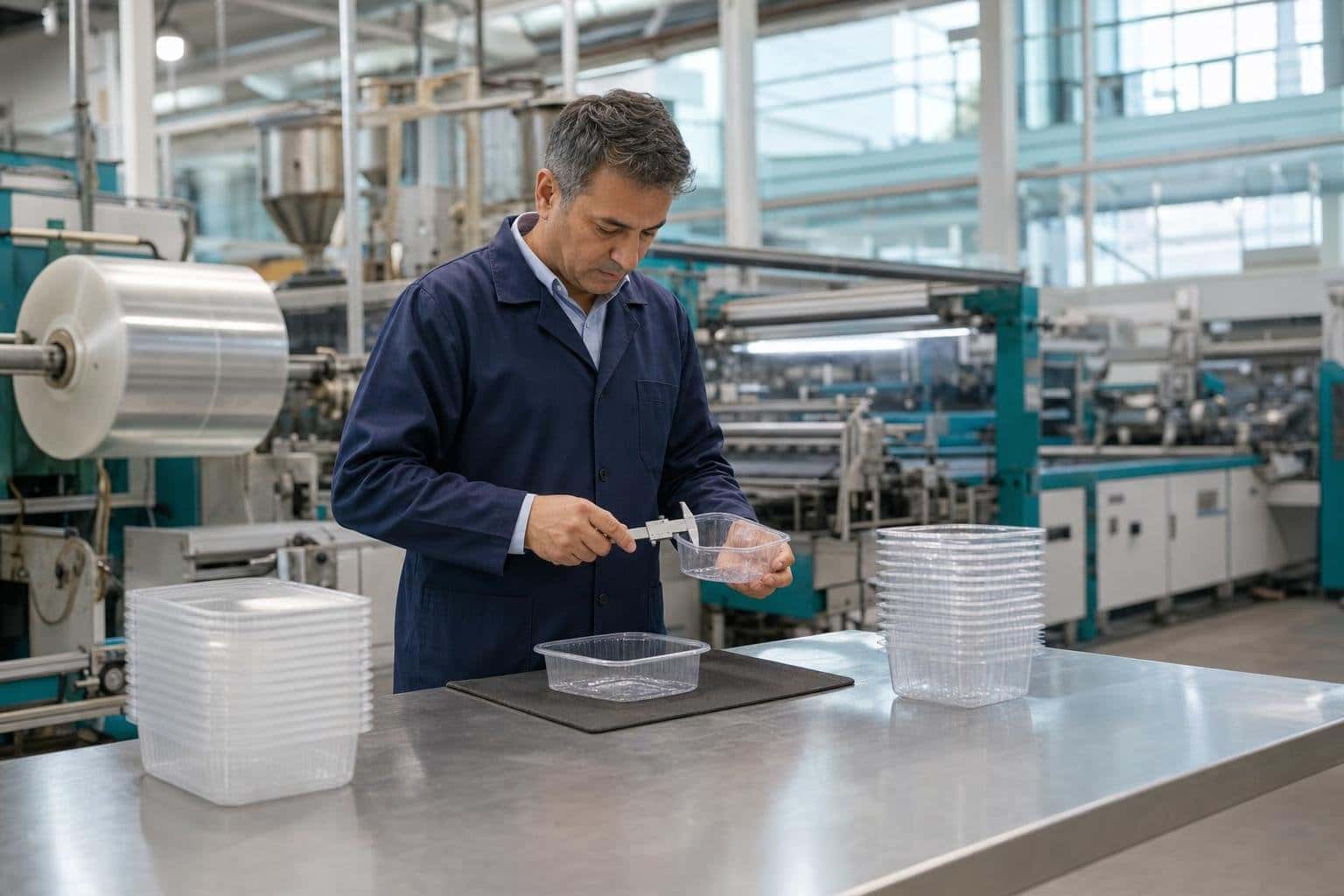
At pre-production, inspect dimensions, fit, closure, print registration and odour where relevant. During production, confirm the agreed sampling plan and batch identification. Before shipment, compare cartons, count, visible contamination, deformation, seal integrity and labelling against the approved specification. An inspection result should state its scope and sample basis rather than promise that every unit was examined.
What quality failures cause the most expensive rework?
Late discoveries usually involve a mismatch between intended use and actual specification, inconsistent wall thickness, weak seals, warped pieces, poor nesting, colour drift, contamination, fragile outer cartons or missing batch traceability. The commercial cost grows quickly when the packing has already been filled, shipped or introduced into a regulated destination market.
Build a hold point before final balance payment or dispatch. Require photos, batch references and an exception log. If the buyer uses a third-party inspection, give that inspector the approved sample and measurable acceptance criteria. A generic request to “check quality” is too vague to be useful.
Can Corpenza help with Turkish packaging supplier due diligence?
Corpenza can coordinate a practical sourcing workstream: supplier screening, specification handover, sample tracking, production follow-up and inspection coordination. The team does not certify food-contact compliance or replace the importer’s legal responsibilities. For wider supplier execution support, see Corpenza manufacturing and production services. To discuss a Turkey packaging project, use the contact page.
FAQ: Turkey plastic food packaging sourcing
Is a supplier statement enough for food-contact packaging?
No. Match the statement and any supporting records to the exact product structure, intended food, contact conditions and destination-market requirements. Keep the document version with the approved specification.
Should the buyer test every shipment?
Testing frequency should follow risk, product history, use conditions and contractual controls. A buyer can combine document review, sample approval, production checks and periodic independent testing where the risk warrants it.
Can a factory replace material after sample approval?
Only under a written change-control process. A change in resin, layer structure, ink, mould or intended use can require a renewed technical and quality review before production continues.
Does a Turkish registration number prove EU compliance?
No. It is one useful Turkish-market traceability check. EU placement requires a separate assessment against the applicable EU and destination-country rules for the specific product.
This article is general information, not legal, food-safety or product-compliance advice. Requirements change and depend on the product, market and intended use.