
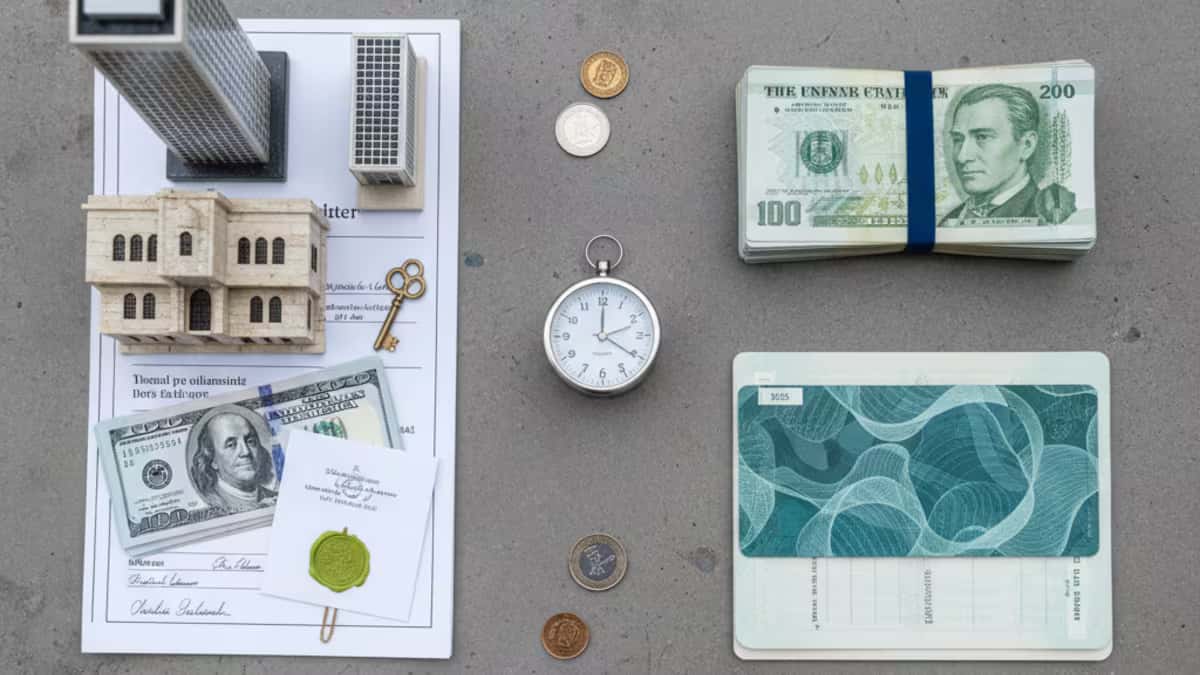
Turkey’s official investment framework lists a qualifying property purchase of at least USD 400,000 and a bank deposit of at least USD 500,000. Both routes carry a three-year restriction. The lower entry figure does not settle the choice. The asset, liquidity plan and evidence file usually do.
What is the official difference between the two routes?
The property route requires real estate worth at least USD 400,000 with a title-deed restriction on resale for at least three years. The deposit route requires at least USD 500,000, or its foreign-currency equivalent, in a bank operating in Türkiye and no withdrawal for at least three years. The official page identifies different attesting authorities for each route.
The Republic of Türkiye Investment Office lists the property route under the Ministry of Environment, Urbanization and Climate Change and the deposit route under the Banking Regulation and Supervision Agency. That distinction matters when preparing the evidence chain.
When does the USD 400,000 property route fit better?
Property fits an applicant who wants to own and hold a Turkish real-estate asset and is comfortable with acquisition work, title-deed formalities and a resale restriction. The route has a lower qualifying threshold, but the purchase price is only one line in the file. Payment records, valuation, title-deed restrictions and timing all need to line up.
Read the detailed USD 400,000 property-route guide before treating the threshold as a budget. A property can be commercially attractive yet still create avoidable file risk if payment and registry records do not support the citizenship application.
When does the USD 500,000 deposit route fit better?
The bank-deposit route fits an applicant who prefers a financial asset over a property acquisition and accepts the higher USD 500,000 threshold. The money must be placed with a bank operating in Türkiye and remain unavailable for withdrawal for at least three years. It is a lock-up, not a generic savings-account shortcut.
The practical work sits in bank onboarding, source-of-funds review, transfer records and the BRSA attestation path. See the focused USD 500,000 deposit-route explanation for that operational layer.
Do both routes have the same three-year commitment?
Yes, the official framework attaches a three-year commitment to both paths, but it takes a different form. The property route uses a title-deed resale restriction. The deposit route uses a non-withdrawal condition. An applicant should model cash needs for the full period before choosing either structure.
| Point | Property route | Bank-deposit route |
|---|---|---|
| Official qualifying amount | USD 400,000 | USD 500,000 |
| Three-year condition | Restriction on resale in the title-deed process | No withdrawal from the qualifying deposit |
| Attestation named by the Investment Office | Environment, Urbanization and Climate Change ministry | Banking Regulation and Supervision Agency |
What documents create the most risk?
For property, the file needs a clean connection between the qualifying purchase, payment trail and land-registry restriction. For deposits, the critical connection is between the bank, the qualifying funds, the lock-up and the relevant attestation. The TKGM citizenship FAQ is a useful official reference for the property-payment and land-registry layer.
Keep commercial due diligence separate from citizenship eligibility. A bank can ask for its own compliance information. A property also needs its own legal, valuation and title checks. Neither route turns approval into an automatic outcome.
Which route is cheaper?
The property threshold is USD 100,000 lower, but a threshold is not the full cost of ownership. Property brings acquisition and holding costs. A deposit leaves a larger amount tied up for three years. Compare the complete cash plan, exit plan and documentation burden rather than calling either route universally cheaper.
Frequently asked questions
Can the property be sold during the three-year period?
The qualifying property route requires a resale restriction for at least three years. Selling before the restriction ends is inconsistent with the route’s stated condition.
Can the deposit be withdrawn early?
The official route states that the qualifying deposit must not be withdrawn for at least three years. Treat early liquidity needs as a route-selection issue before funds move.
Does opening an account guarantee the deposit route?
No. Bank onboarding and the citizenship route are separate decisions. The bank’s compliance review and the authority’s assessment each have their own requirements.
Does a USD 400,000 purchase alone complete the property route?
No. The threshold is one condition. The title-deed restriction, payment evidence and the relevant eligibility process also matter.
This is general information, not legal, tax or investment advice. Rules and evidence requirements can change, and authorities decide each application.
For a route-specific file review, contact Corpenza before committing funds. Also check the current Turkey CBI legal-updates guide.