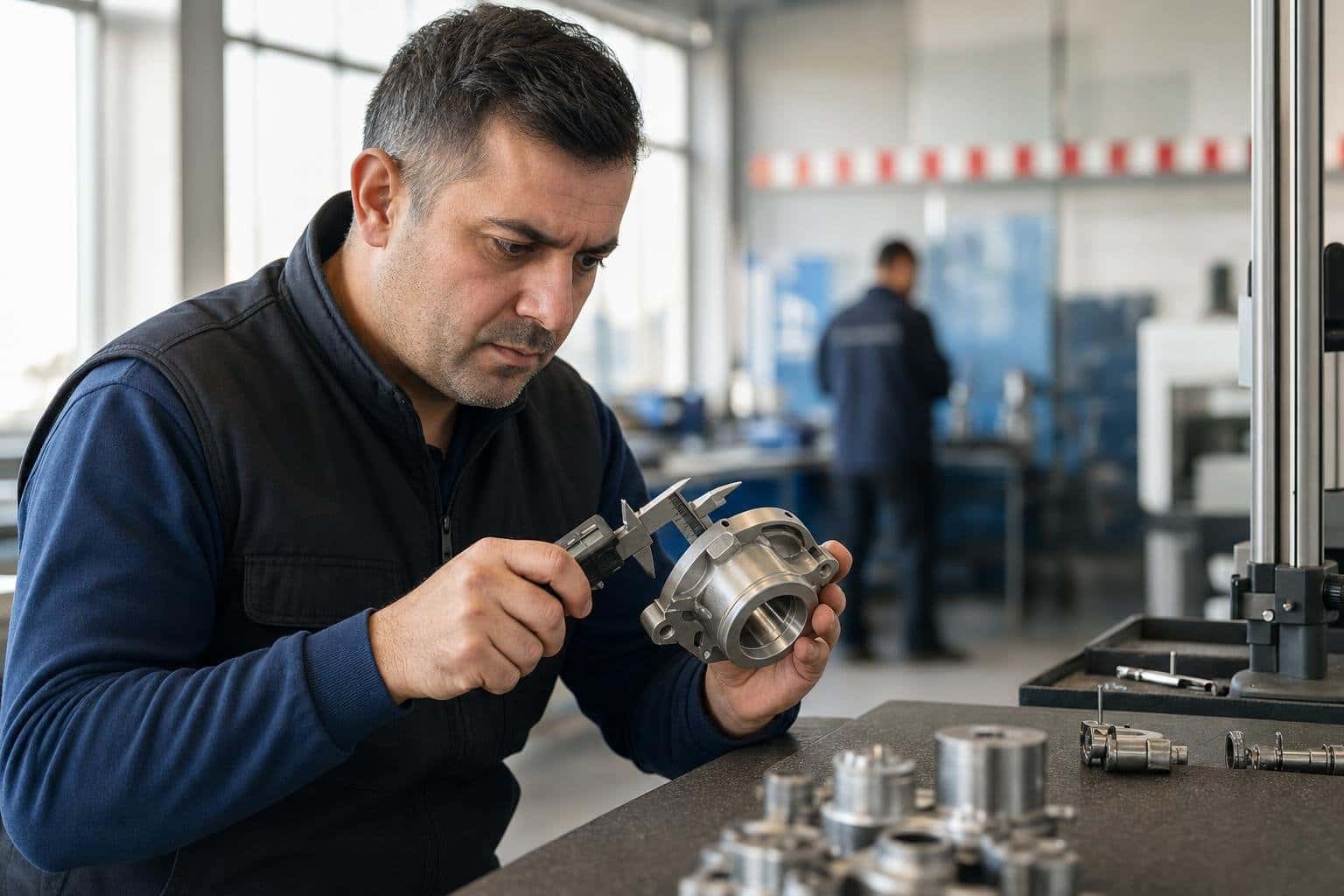
Buying automotive parts from Turkey is not a catalogue exercise. A part can look right in a quotation and still fail when the supplier’s process, measurement method, material traceability or change control is tested at production speed. Start the sourcing decision with a qualification file, then decide whether a PPAP-style submission is needed for the part and customer programme.
What should a buyer qualify before awarding an automotive part?
First establish who will actually make the part. Match the legal entity on the quotation, purchase order, invoice and bank instructions to the production-site address. Türkiye’s Ministry of Trade describes MERSİS as the central electronic trade-registry system. It is useful for legal-entity discipline; it does not prove a factory’s technical capability.
Then make the RFQ measurable. Identify the drawing revision, material standard, critical dimensions, surface or heat-treatment requirements, annual volume, packaging, test method, traceability expectation and destination-market requirements. “Automotive quality” is not a specification. A candidate should answer with a process route and a list of evidence, not a generic certificate deck.
Which factory questions reveal real capability?
Ask the supplier to map each operation: incoming material control, tooling, machining or forming, special processes, assembly, inspection, packing and dispatch. For every critical characteristic, ask where it is measured, with which gauge, at what frequency, and what happens when a result falls outside the limit. If a supplier subcontracts plating, molding, heat treatment or testing, name the subcontractor and put that activity inside the approval plan.
Request recent, relevant evidence rather than a broad claim: a redacted control plan, a sample inspection record, gauge-calibration status, nonconformance handling and a production-capacity view for the nominated line. Do not treat a scan of a management-system certificate as product approval. It may support a conversation, but the part still needs its own controlled evidence.
What is PPAP, and when should you ask for it?
AIAG’s PPAP-4 page describes the Production Part Approval Process as the minimum documentation a supplier submits for customer approval before shipping production quantities. In practice, the buyer and customer programme determine the exact submission level and evidence. Do not promise a particular level or approval outcome in an RFQ; agree it in writing with the customer’s requirements.
For a new or changed production part, the useful question is not “Do you have PPAP?” It is “Can you submit the agreed package for this drawing revision, from this manufacturing route, before serial shipment?” Typical requests can include design records, process flow, risk analysis, control plan, dimensional results, material or performance evidence, sample parts and a part-submission warrant. The required content depends on the applicable customer and programme rules.
How should the first-order control plan work?
Set gates before money and material become difficult to recover. Approve the legal identity and technical feasibility first. Next approve the development sample and document pack. Run a pilot or first-off check where the part warrants it. During production, inspect characteristics that can no longer be corrected after a later operation. Before shipment, verify count, labeling, packaging, records and the release decision.
Turkey’s standards body, TSE, says its special-surveillance scope includes supplier/dealer evaluation, second- and third-party surveillance, conformity monitoring against specifications, standards, regulations and customer requirements, and pre- and post-loading surveillance (page published 29 March 2023; modified 28 July 2023). This is an available service scope, not proof that an individual supplier has passed an audit.
What should be checked in a supplier audit?
Watch the process, not only the meeting room. Compare the stated routing with the machines running on the floor. Look for part identification between operations, segregation of suspect material, revision control at workstations, preservation of gauges, and a clear response when a defect is found. Ask the quality owner to walk through one real nonconformance from detection to disposition and corrective action.
A remote audit can screen candidates, but it is weaker for verifying line ownership, material flow and operating discipline. For higher-risk or high-value parts, define the audit scope, sample size, evidence list and report format before arranging a visit. An audit creates evidence for a point in time; it does not guarantee every later batch.
How do commercial and compliance checks fit together?
Commercial controls should follow the technical file: agreed Incoterm, price basis, tooling ownership, payment milestone, confidentiality, quality claim route, rework/replacement rules and change-notification duty. If the buyer needs a Turkish entity for recurring local operations, Invest in Türkiye states that international investors may establish company forms under the Turkish Commercial Code and that registration transactions are carried out through MERSİS. Entity setup is an operating decision, not a substitute for supplier qualification.
Before contract signature, separate three questions: can this factory make the part; can it document conformity to the agreed requirement; and can the cross-border transaction meet the destination market’s import and product-compliance rules? The final question needs the destination authority’s requirements, not a Turkey-only checklist.
Buyer checklist
- Verify legal entity, site and invoicing party.
- Freeze drawing revision and critical characteristics.
- Identify subcontracted or special processes.
- Agree the PPAP-style submission requirement for the programme.
- Approve sample, evidence pack and change-control rule before serial production.
- Set inspection gates and a written defect-escalation path.
- Confirm destination-market compliance separately.
FAQ
Does every Turkish automotive supplier use PPAP?
No. PPAP requirements come from the customer programme and agreed supply terms. Ask about the supplier’s experience, then specify the submission required for the part.
Is an audit enough to approve a supplier?
No. It is one input. Approval should also cover the part-specific sample, documents, capacity, commercial terms and compliance requirements.
Can a buyer rely on a certificate alone?
No. A certificate does not show that the nominated process can make the exact part to the current drawing revision.
Corpenza can coordinate supplier shortlisting, legal-entity checks and a buyer-side control plan for manufacturing projects in Türkiye. Discuss a sourcing project. This is general information, not legal, engineering or product-compliance advice.