
Buying fabricated metal parts in Turkey starts with the engineering file, not the price list. A capable supplier still needs a clear drawing, an agreed inspection point, and a packing instruction that survives the route to the customer. This guide sets out a practical 2026 buying process for laser-cut, bent, welded, and assembled sheet-metal parts.
Turkey has a real industrial base, but no country-level statistic can approve a factory for you. The official Invest in Türkiye machinery profile reports USD 57.8 billion of 2024 machinery-sector revenue, 502,000 employees, USD 28.7 billion of 2025 exports, and exports to more than 200 destinations. Those figures are useful context for a shortlist. They are not a substitute for supplier qualification.
Why source sheet metal fabrication from Turkey in 2026?
Turkey is worth assessing when the project needs repeatable fabrication plus practical access for sampling, corrective work, and shipment control. The official logistics profile places Türkiye within a four-hour flight radius of 67 countries with combined GDP of USD 30 trillion and 1.3 billion people. That reach can shorten the feedback loop. It does not guarantee a lower landed cost.
For a buyer, the useful question is narrower: can the proposed factory hold the drawing revision, material grade, bend geometry, surface finish, and delivery window? Ask that before comparing unit prices. A quote without those answers is only a starting point.
What should an RFQ include?
A usable RFQ gives the supplier enough information to price the same job that you intend to buy. Send the drawing revision, CAD format where available, annual and batch volumes, material standard and thickness, tolerances, finish, required certificates, inspection plan, packing method, destination, and Incoterm.
Call out cosmetic surfaces separately. A powder-coated enclosure and an internal bracket should not be inspected to the same visual standard. If a weld has to be ground flush, say so. If burr direction matters for assembly, put it in the drawing or inspection note rather than leaving it for a post-sample email.
How do you screen a Turkish metal supplier?
Start with evidence that the supplier can make the part, then test whether its operating controls match the job. Ask for machinery lists, material traceability practice, sample photos linked to comparable work, quality records, export packing examples, and the person who owns engineering changes. A plant visit or a remote video walk-through should follow for higher-risk work.
Split the screen into capability and control. A supplier can own a laser cutter yet outsource coating, welding, or final assembly. That is not automatically a problem. It becomes one when the quotation hides the subcontracting chain or nobody owns the final inspection.
Where do quality checks belong?
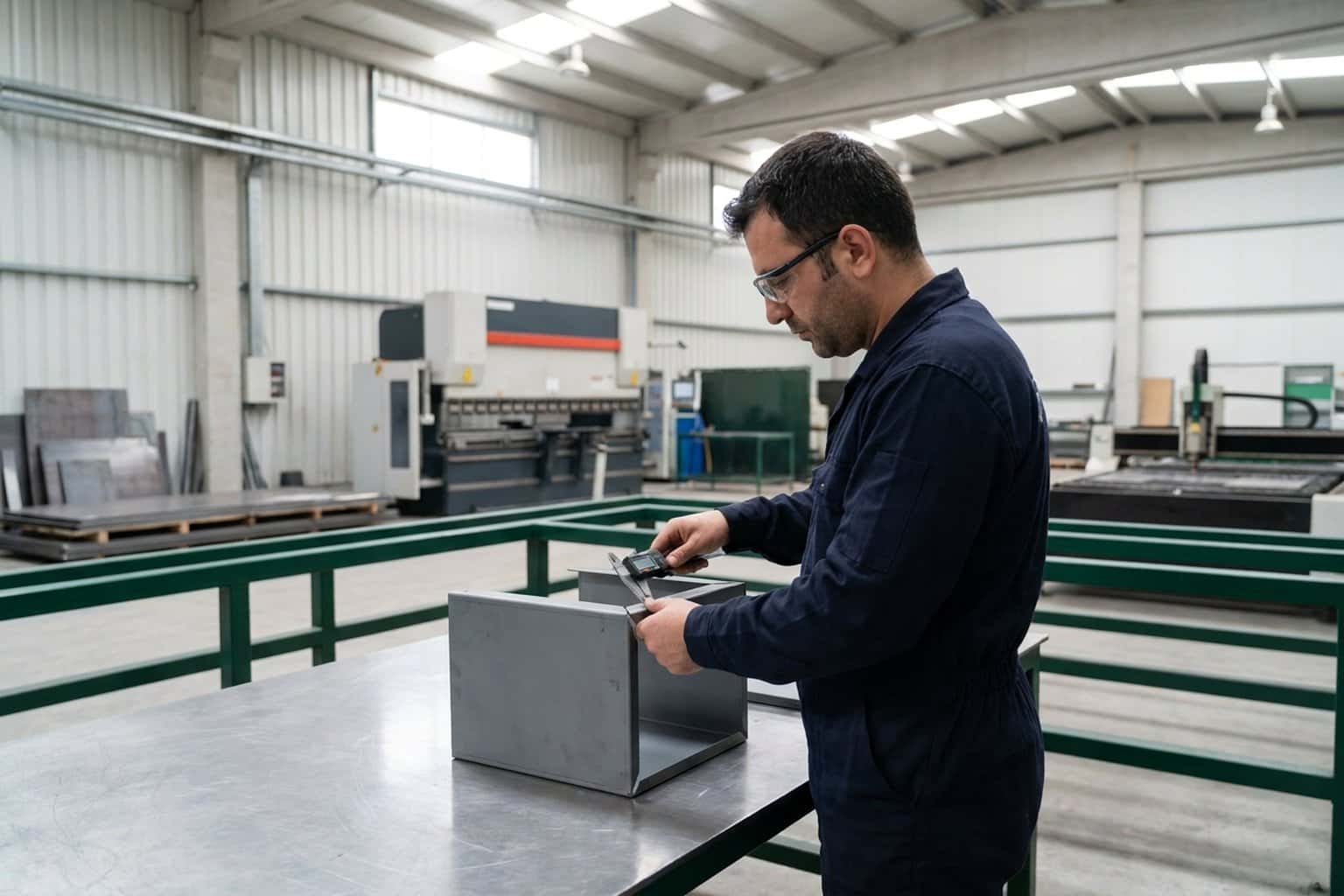
Quality control should begin before production and continue through loading. Confirm the first-off sample against the drawing, then agree which dimensions, finish points, and assembly functions are checked during the run. Hold a final inspection before the goods are packed, not after the truck has left.
Turkey has an official surveillance-service framework. TSE lists supplier and dealer evaluation, second- and third-party surveillance, conformity checks against specifications, standards, regulations or customer requirements, and pre- and post-loading surveillance on its special surveillance activities page. That means structured oversight is available. It does not mean a TSE service has pre-approved any individual supplier.
How should buyers handle finish, packing, and shipping?
Finish disputes usually begin with an incomplete reference. For paint or powder coating, agree the color reference, gloss range, texture, masking, corrosion expectation, and acceptable edge condition. For stainless or aluminum, specify grain direction, protective film, and how marks are assessed under normal light.
Packing needs the same level of detail. Define separators, edge protection, moisture control where relevant, pallet dimensions, stack limits, marks that must remain unreadable to third parties if confidentiality is required, and photo evidence before loading. A clean part can still arrive unusable after poor palletization.
Do you need a Turkish company to buy fabricated parts?
Occasional sourcing can often be managed without a local entity. A local structure becomes more useful when the buyer needs resident staff, regular inspections, a warehouse, recurring domestic contracts, or a broader operating presence. The legal and commercial decision should be reviewed separately from the supplier quote.
The Invest in Türkiye business-establishment guide states that international investors have the same rights and liabilities as local investors and describes Trade Registry Directorates as a one-stop shop. Its same-day wording applies to the registry process when the filing is ready; it is not a promise that a foreign buyer's complete operating setup will always finish in one day. Corpenza can support company formation and accounting and manufacturing oversight where the project needs a local operating layer.
What is the practical buying sequence?
Run the project in gates: qualify the supplier, lock the RFQ, approve a sample, set in-process checks, inspect the finished lot, and release the loading evidence. Keep one owner for drawing changes. Small changes to a hole pattern, bend radius, coating, or carton count can otherwise travel through email without reaching the shop floor.
The cheapest first quote rarely tells the whole story. A dependable purchase order records what will be made, how it will be checked, who accepts a deviation, and when goods are safe to load.
Frequently asked questions
Is Turkey always cheaper for sheet metal parts?
No. Compare the delivered specification, inspection effort, packing, freight, duty treatment, and rework risk rather than a unit price alone.
Can a buyer inspect before shipment?
Yes. Build pre-loading inspection and photo evidence into the purchase order. TSE also describes pre- and post-loading surveillance among its available services.
What is the most common RFQ failure?
Leaving materials, tolerances, surface expectations, or revision control unclear. The supplier then prices assumptions that may not match the final requirement.
Should a buyer use one supplier for every process?
Not necessarily. The important point is transparency about outsourced steps and a clear party responsible for final conformity.
This is general information, not legal, tax, engineering, or procurement advice. Requirements depend on the product, contract, and destination market.
Need a buyer-side sourcing and inspection plan for Turkey? Contact Corpenza to discuss the operating steps before placing an order.