

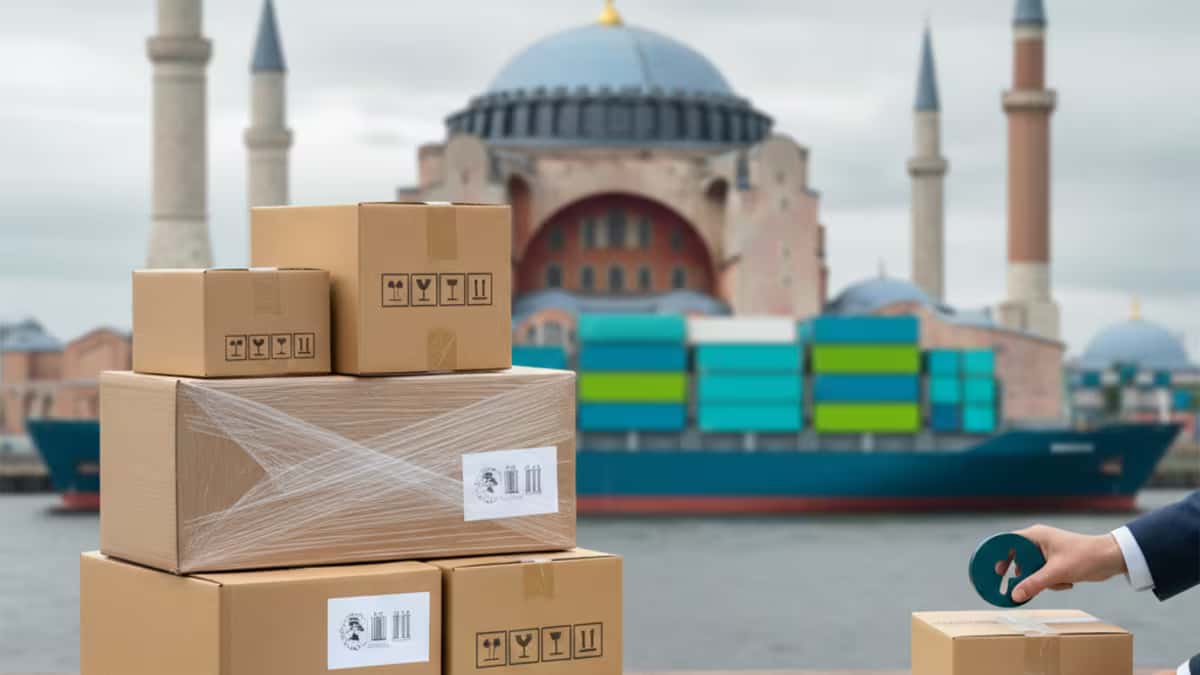
Packaging and labeling requirements for Turkish exports are rarely one checklist you can reuse forever. The carton, retail label, country-of-origin mark, fibre statement, warning line, barcode layout, and pallet treatment rule all move with the product and the destination market.
That is why experienced exporters freeze the packaging file late enough to include the live market rules, but early enough to avoid reprinting. If Turkey is already part of your supply plan, Corpenza's Turkey sourcing guide, sample-development guide, nearshoring article, and import-export business guide are the right supporting reads.
What do packaging and labeling requirements actually cover for Turkish exports?
They cover every physical and printed element that customs, the importer, the warehouse, and the final customer will rely on. That includes retail labels, shipping marks, origin references, pallet treatment status, inner-pack details, carton data, and the packing list that must still match the goods after the truck doors open.
Some rules sit on the product. Others sit on the sales pack, the master carton, or the pallet. A textile label can be correct while the export carton is still wrong. A good-looking retail box can still create a border problem if the origin marking is weak or the pallet is non-compliant.
So the file should be managed as one operational pack. Artwork, barcode placement, carton marks, packing list, and pallet method need the same owner before shipment.
Why is there no single universal label file for every market?
Because destination markets apply different product rules, language rules, customs processes, and market-entry controls. One label that works for a Turkish export to one country can be incomplete, misleading, or non-compliant in another market, even if the product itself has not changed.
The European Commission's Access2Markets labelling and packaging page says extra requirements may apply depending on the destination EU country, and it lists product-specific EU labelling regimes for foodstuffs, footwear, textiles, tyres, wine, and more. Its wider Guide for Export of Goods also reminds exporters to check import requirements in the target market before shipping.
That means the safe question is never, "What is the Turkish export label?" The safe question is, "What must this exact product show in this exact market, and at which packaging level?"
Which exporter data should be frozen before the first print run?
Freeze the product identity, importer identity, origin language, carton hierarchy, barcode logic, and transport unit count before you approve artwork. Most expensive relabeling jobs start when the commercial file keeps changing after packaging has already been ordered.
At minimum, lock the product description that will appear on the invoice and pack list, the net and gross quantities, the country-of-origin wording, the customer-specific SKU or barcode set, and the party responsible for local compliance review. If the importer wants a private-label line, that has to be confirmed before mass printing.
It also helps to decide what stays on the retail unit and what moves to the outer carton. Some markets want consumer information on the sales pack. Some warehouse operators care more about pallet labels, carton numbering, and scannable shipping marks.
What changes when the target market is the EU?
The EU file usually splits into two layers: customs access and product-market compliance. Customs participants may need an EORI number, while the product itself must still meet the relevant EU or country-level labelling and packaging rules before it is placed on the market.
The European Commission's EORI guidance says an EORI number is mandatory for customs operations in the EU such as import, export, and transit. Access2Markets also says packaging marketed within the EU must comply with general requirements and, where applicable, specific provisions designed to protect consumers and the environment.
For Turkish exporters, the practical takeaway is simple. Do not treat the EU as one generic sticker. Check the HS code, the product category, the importer setup, and the destination member state before anything is printed in volume.
What changes when the target market is the UK or the United States?
Both markets expect the imported product to meet their own marking and labelling rules before sale, but they do not ask the same questions in the same way. The UK file is product-standard driven. The U.S. file is especially sensitive to origin marking, invoicing accuracy, and package-level identification.
GOV.UK's UK standards and regulatory import requirements page says that before you can sell a product imported into the UK, you must comply with the relevant marking standards and the applicable labelling standards. The Turkish Ministry of Trade's U.S. technical-barriers page says imported goods generally need the country name marked in English, legibly and permanently, and it recommends package marks and numbers that match the invoice.
That makes the review sequence important. If the UK and U.S. are both in scope, prepare separate compliance checks. Do not assume the same retail label, carton mark, or origin statement can move unchanged between both lanes.
How can transport packaging and wood pallets delay a Turkish export?
Transport packaging causes delays when the outer pack is undocumented, the pallet labels do not match the shipment file, or the wood packaging material fails plant-health rules. This is one of the most common places where a shipment that looked commercially ready stops feeling border-ready.
The IPPC's ISPM 15 standard page says the standard covers raw-wood packaging material, including dunnage, and excludes processed wood such as plywood. GOV.UK's wood packaging guidance says solid wood packaging used for import or export must meet ISPM 15 requirements and warns that non-compliant packaging can be rejected or destroyed.
In practice, exporters should confirm pallet type, heat-treatment status, marks, and dunnage method before loading day. Reworking pallets after the truck arrives is slow, visible, and expensive.
What should a pre-shipment packaging review include?
A serious pre-shipment packaging review should compare the physical goods, the printed packaging, and the customs file line by line. If one layer tells a different story from another, correct it before release. The final hour is a bad time to discover that the label, the carton, and the invoice describe three slightly different products.
The review should cover the retail label text, origin wording, importer details if required, barcode scan test, carton count, master-carton marks, packing list match, pallet count, and wood-packaging status. For sensitive lanes, add photo evidence of the final packed goods and at least one pallet face.
If the file is moving across several factories or subcontractors, use Corpenza's local team to keep one approval trail between manufacturing, packaging, and export operations. That usually costs less than one rushed relabeling cycle at the warehouse.
Frequently asked questions
Can one English label work for every Turkish export market?
No. Some markets need local-language content, some care about origin formatting, and some ask product-specific fields that another market does not use.
Is the packing list part of the packaging file?
Yes in practice. The physical packaging and the packing list have to tell the same story, or customs and warehouse checks become harder.
Do wood pallets matter if the retail packaging is perfect?
Yes. A perfect retail box does not cure a non-compliant pallet. ISPM 15 issues can still delay or damage the shipment.
Should the importer approve artwork before mass printing?
Usually yes. The importer or local compliance owner should approve the final market-facing text before the main run starts.
Is this legal or tax advice?
No. This is general information, not legal or tax advice. Product, market, and customs details change the right answer.
When Turkish exports need one clean packaging file across suppliers, Corpenza's production team and import-export team can align packaging approval, carton logic, shipment readiness, and destination-market checks before the goods move.