
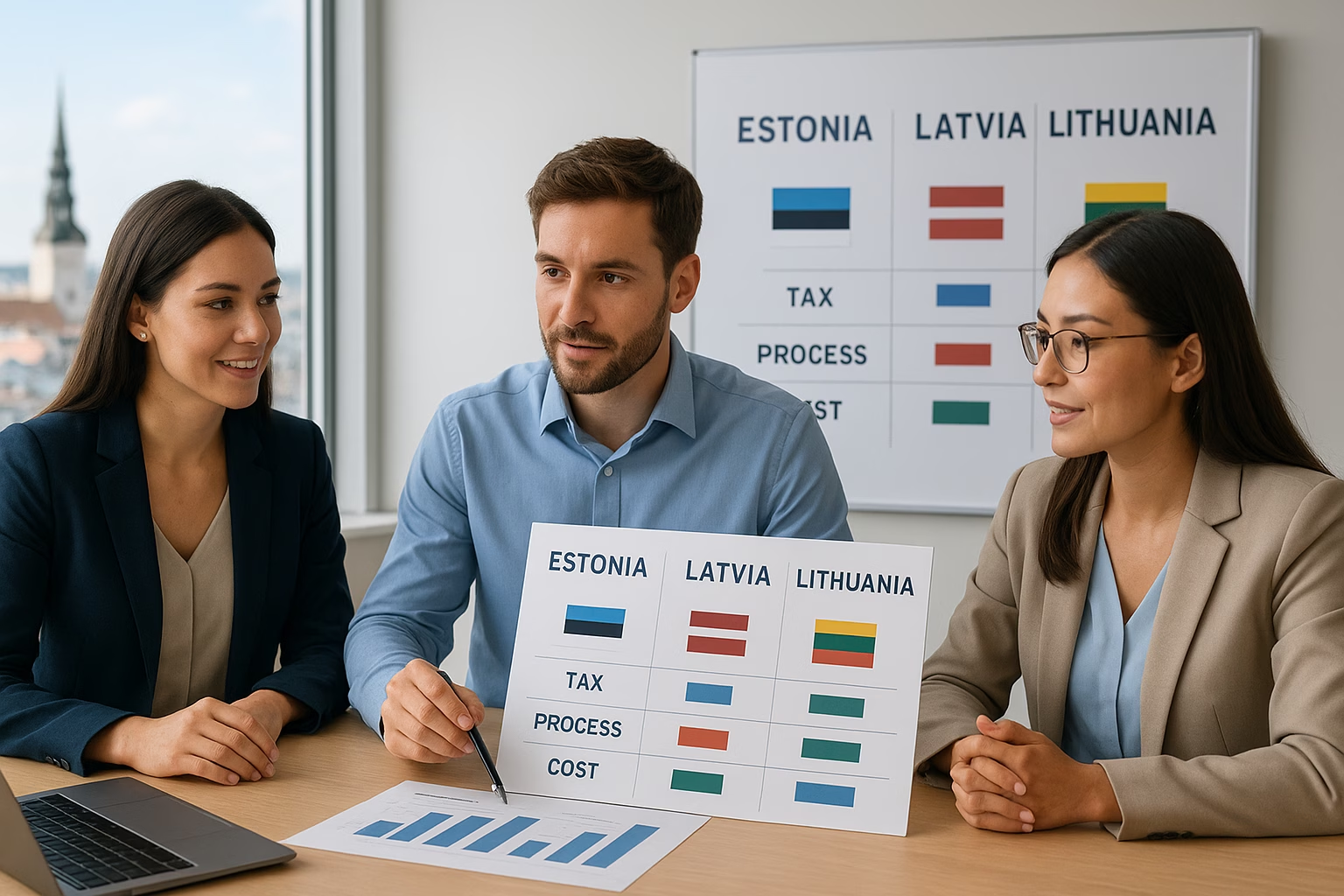
Why are the Baltics at the center of the “company formation” agenda?
The Baltic countries (Estonia, Latvia, Lithuania) offer a strong alternative set for entrepreneurs seeking rapid corporate formation, a predictable tax framework, and ease of doing business digitally within the European Union. However, “starting a company in the Baltics” is not a one-size-fits-all package: each country’s corporate tax system, formation speed, minimum capital, incentive structure, and compliance/accounting dynamics differ.
The aim of this comparative report is to clarify which Baltic country fits which business model better and to accelerate the decision-making process. We will highlight critical distinctions, especially for reinvestment-focused startups, service companies selling to the EU, R&D/IP-focused technology firms, and groups considering holding structures.
Defining the need: Not the “cheapest country,” but the “most suitable country”
The most common mistake in company formation is making decisions based on a single metric: only the corporate tax rate, only the formation cost, or only whether “online company formation is possible.” However, the real question is: How long will the company profit stay in the business, how much will be distributed, and which activity (trade, software, R&D, holding) will be predominant?
For example, the “ideal country” choice will not be the same for a company that plans to reinvest most of its profits back into the business each year compared to a company that plans to distribute dividends. Similarly, a firm developing R&D and patented products should look at mechanisms such as R&D deductions and patent boxes rather than just the corporate tax rate.
The fundamental distinction in corporate tax systems: Deferred tax vs. classical model
At the heart of the Baltic comparison lies the tax system. Estonia and Latvia differentiate themselves with a deferred taxation approach in corporate tax: companies do not pay taxes on undistributed profits; tax is triggered when profit distribution (dividends or similar distributions) occurs. Lithuania, on the other hand, adopts a more traditional corporate income tax structure.
This difference has a direct impact on cash flow management. In ecosystems where profits are retained and reinvested during growth periods, deferred tax effectively eases company financing. In contrast, in structures planning regular dividends, the effective burden becomes more visible, and the choice of country varies.
Tax rates: What does the table say?
- Estonia: Standard corporate tax rate 22%. For undistributed profits, 0%.
- Latvia: Standard rate 20% (expressed as 25% effective by some calculation methods). For undistributed profits, 0%.
- Lithuania: Standard corporate tax rate 16%. Undistributed profits are generally taxed at 16%.
In summary: for companies with high profit retention rates, Estonia and Latvia naturally stand out. Lithuania competes with different and strong incentives (especially R&D/IP) instead of “deferring tax until distribution.”
Capital gains and structuring perspective
Another notable aspect in the comparison is the approach to capital gains and the areas of exemption. Data shows that the full exemption approach for capital gains is stronger in Estonia and Latvia, while in Lithuania, capital gains can be addressed within the corporate tax framework. This distinction requires further analysis in partnership structures with share transfer plans and investment exit scenarios.
Formation processes and costs: speed and capital threshold
The most common type of company in the Baltic countries is the limited liability company format: OÜ in Estonia, SIA in Latvia, UAB in Lithuania. The reason for preference is the relatively simple formation procedure and manageable capital requirements.
Minimum capital, duration, and fee comparison (summary)
- Estonia: Minimum capital €0.01; formation fee €200–265; formation duration 1–3 days.
- Latvia: Minimum capital €2,800; formation fee/duration not clearly specified in the data.
- Lithuania: Minimum capital €1,000; formation fee/duration not clearly specified in the data.
The most critical result in this table is clear: Estonia leads in speed and capital flexibility. Thanks to the electronic formation procedure, it can progress within the 1–3 business day range and the symbolic capital threshold, creating an advantage especially for startups aiming for a “quick market entry.”
Digital infrastructure and ease of doing business: Why is Estonia in a separate place?
When discussing digital infrastructure within the Baltics, Estonia’s position becomes clear. Estonia’s e-Residency program allows foreign entrepreneurs to establish companies online and manage operations remotely. This is particularly important for founders who want to structure operations within the EU without being physically present in the country.
However, not every advantage of Estonia is “absolute”: data emphasizes that businesses need to plan carefully regarding access to skilled human resources and relatively small domestic market. In other words, while Estonia is close to perfection in digital processes, it requires strategy on the “local hiring and scaling” side.
Business environment and political/financial risks: Why is credit rating discussed?
In international expansion, not only tax but also country risk metrics are important. According to Standard & Poor’s credit ratings, Estonia is noted to have an AA- rating, while Latvia is rated A+. Such indicators can influence banking relationships, long-term investment decisions, and country risk perception.
On the other hand, research data describes the overall political climate of the Baltic region as stable and conducive for global businesses. Nevertheless, each company must evaluate country risk within its own framework based on the sector it operates in, supply chain, and regulatory sensitivities.
Tax incentives “what does each offer?”: A country-based net reading
All three countries have different strong points. Providing a targeted answer to the question “which category does my business fall into?” during the decision phase reduces the cost of choosing the wrong country.
Estonia: Strong for companies retaining profits and growing
- Ideal profile: Growth-stage companies focused on reinvestment.
- Key advantage: 0% tax on undistributed profits (tax is triggered upon distribution).
- Note: There is a “standard deductions” approach on the R&D side; R&D-intensive firms should compare with Lithuania as well.
Latvia: Deferred taxation + micro-enterprise regime
- Ideal profile: Scalable service or trade companies seeking location/access advantages in EU operations.
- Key advantage: 0% on undistributed profits like Estonia; 20% rate on distributions (compared to Estonia’s 22%).
- Additional element: The micro-enterprise regime (noted as 25% in the dataset) can create alternatives under certain scales and conditions.
Lithuania: The most comprehensive package for R&D and intellectual property (IP) focused businesses
Lithuania stands out with depth of incentives rather than deferred taxation. It offers important tools especially for companies developing technology, producing patented products, or investing in R&D:
- Triple R&D deduction
- Patent box
- 7 free economic zones
- Full corporate tax exemption for large projects (up to 20 years)
Large Project relief is also noteworthy: According to data, businesses that meet the conditions of €20–100 million in capital investment and 150+ employees (in Vilnius, 200+) can receive a full corporate tax exemption for up to 20 years. This can dramatically affect the country choice for groups planning large-scale production/technology investments.
Startup ecosystem signal: What the numbers say
As the Baltics become a rapidly growing hub for technology startups, different densities emerge at the country level. According to data, of the 34,000 companies established in the Baltic countries by 2025, only 20% are from Latvia. Such ratios do not alone indicate the “best country”; however, ecosystem density, investment networks, mentorship, and talent pool can indirectly signal such aspects.
Law, accounting, and compliance: Hidden costs
The decision to establish a company does not end with the registration day; real life begins with accounting and tax compliance. Research data emphasizes that although the Baltic countries may seem similar, the differences can be significant in practice. Particularly, frequently changing tax laws in Lithuania can create a constant need for updates in accounting procedures.
At this point, a country that appears to have “low formation costs” can create unexpected operational burdens in areas such as regular reporting, payroll, VAT processes, transfer pricing, or intra-group billing arrangements. Therefore, preliminary analysis should be conducted on the following topics when making a decision:
- Revenue model: Is it B2B service, e-commerce, or IP licensing?
- Profit policy: Retaining profits or distributing dividends?
- Employment plan: Local hiring, remote team, posted worker/EOR structure?
- Compliance intensity: VAT, payroll, reporting periods, audit requirements
Which Baltic country fits which strategy best? (practical matching)
- If you aim for “fast setup + growing by retaining profits in the business”: Estonia is generally the best starting point (formation in 1–3 days, €0.01 capital, 0% tax on undistributed profits).
- If you are looking for “deferred tax + alternative regime at certain scales”: Latvia supports a similar logic to Estonia with a 20% distribution rate and micro-enterprise regime option.
- If your focus is on “R&D/IP, patents, large investment incentives”: Lithuania offers strong levers such as triple R&D deductions, patent box, and exemptions for up to 20 years under large projects.
Consider this matching as a “first filter.” The final decision should be made alongside partnership structure, funding plan, target market, transfer pricing, and payroll/employment model.
How does Corpenza create value in this process?
While company formation in the Baltic countries often appears as “filling out forms and getting registered,” true success comes with the right country selection and end-to-end compliance design. Corpenza offers an approach that aligns the tax framework with your business model, sustaining post-establishment operations with experience in company formation and mobility across Europe and globally.
The areas where we create the most value in practice are:
- Country selection and structure design: Determining the most suitable Baltic country based on profit distribution plan, investment/exit scenario, IP, and billing flow.
- Company formation and corporate governance: Structuring the right company type, capital plan, signing authorities, and operational requirements.
- International accounting & payroll: Establishing payroll processes, reporting, and regular compliance.
- Employment models: Operational planning in scenarios such as sending personnel abroad, EOR/payroll solutions, and tax optimization with posted worker models.
This approach reduces risks and saves time for businesses that want to not only “set up” but also operate smoothly after establishment.
Conclusion: The Baltics are not a single answer, but three separate strategies
When choosing between the Baltic countries, the question “which is better?” should be transformed into the question: which is more suitable for my company? Estonia stands out for growth-oriented companies with its digital speed and deferred taxation advantage. Latvia offers a similar tax logic with different rates/additional regimes. Lithuania, despite its more classical tax structure, provides a strong alternative especially in technology and large investment incentives with R&D.
The right setup emerges when you address tax, compliance, employment, and operational realities together. Therefore, conducting a professional assessment before making a decision significantly reduces potential costs and the need for restructuring in the following years.
Disclaimer
This content has been prepared for general informational purposes; it does not constitute legal, tax, or financial advice. Legislation and practices may vary by country, sector, and specific case; they may also be updated over time. We recommend checking current official sources and seeking support from professionals in the field before making decisions.